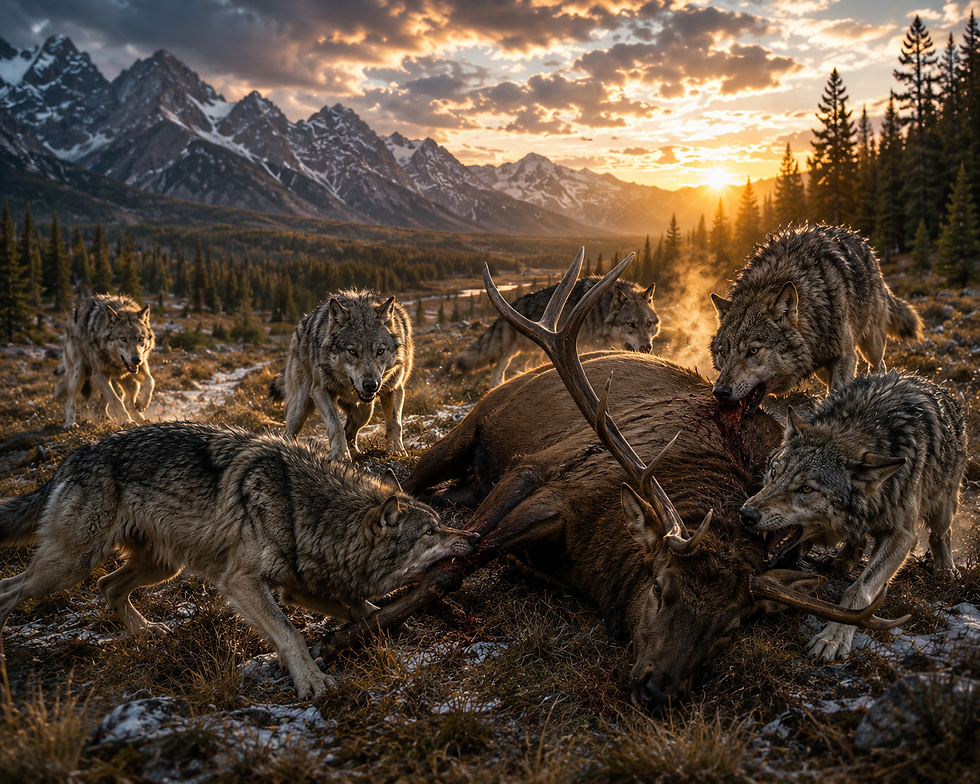
DIET & HUNTING
Wolves are primarily carnivorous predators whose diets are strongly influenced by the prey available in their environment. They commonly hunt hoofed mammals such as deer, elk, moose, caribou, and other ungulates, but their diet can also include smaller mammals, livestock where conflict occurs, birds, fish, and other available foods.
Wolves are opportunistic feeders and do not always hunt the largest animal available. The size and type of prey they pursue can depend on local conditions, prey abundance, season, terrain, and the size and experience of the pack.
Hunting requires a significant amount of energy, and a successful hunt is never guaranteed. Wolves may spend considerable time traveling, searching for prey, tracking, testing, and pursuing animals before making an attempt.
A wolf pack can cooperate during a hunt, with individual wolves responding to the movements and behavior of both their pack members and their prey. Cooperation can help wolves pursue, surround, or separate prey, although not every hunt involves every member of the pack.
Wolves often target vulnerable individuals, including young, old, injured, sick, or otherwise weakened prey. Selecting vulnerable prey can reduce the risks and energy costs associated with hunting healthy adult animals.
Speed is not the only advantage wolves use when hunting. Their endurance allows them to travel long distances and maintain pursuit when conditions are favorable. They can also use terrain, vegetation, snow, and other features of the landscape to their advantage.
Wolves have powerful jaws and specialized teeth that allow them to grip, tear, and consume meat. Their feeding behavior is adapted to making efficient use of a carcass, particularly when food is limited or competition from other animals is present.
When a kill is made, wolves may consume large amounts of food in a short period. This ability is important because successful kills can be unpredictable, and wolves may need to take advantage of available food while they have access to it.
Wolves do not waste energy hunting without reason. Because pursuing prey can be physically demanding and dangerous, wolves must balance the potential nutritional reward against the effort and risk involved.
After feeding, wolves may travel away from a carcass, rest, or return later if food remains available. Other scavengers may also visit a carcass, creating competition and interaction between wolves and other species.
Food availability has a major influence on wolf populations. Areas with abundant suitable prey can support more wolves, while limited food resources can lead to larger territories, greater travel distances, and lower population densities.
Through their hunting and feeding behavior, wolves also influence the animals and ecosystems around them. Their presence can affect prey behavior, carcass availability, and the distribution of food resources used by other animals.
For wolves, hunting is more than simply catching prey. It combines physical endurance, sensory abilities, learning, cooperation, decision-making, and adaptation to constantly changing conditions.