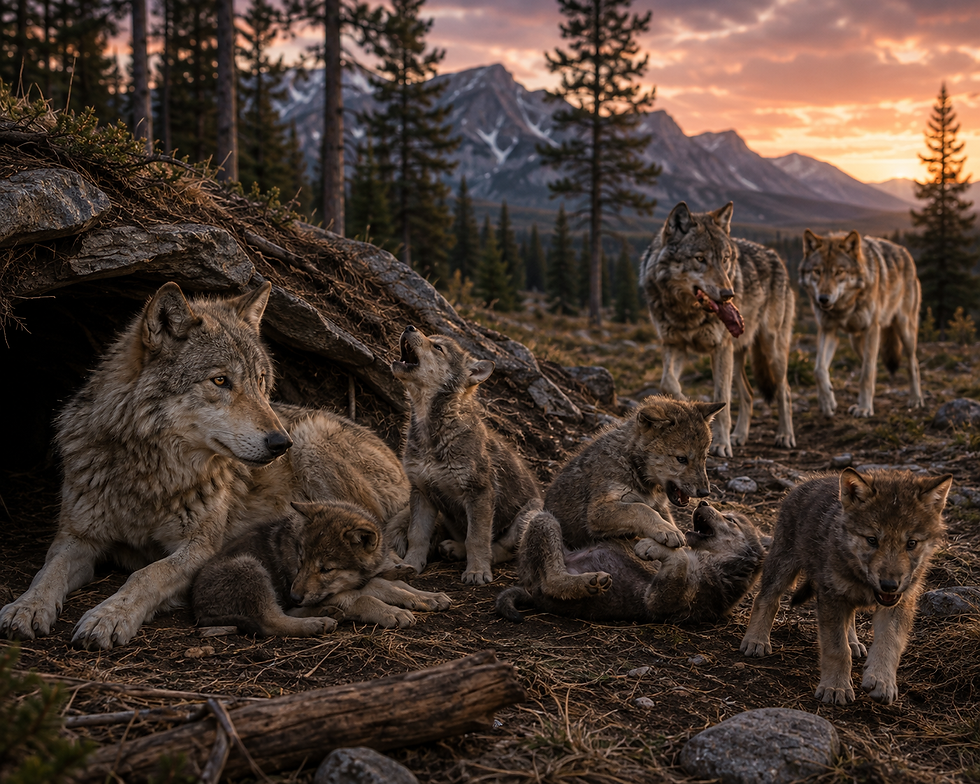
REPRODUCTION & RAISING PUPS
Wolves generally reproduce once a year. In many populations, breeding occurs during the winter months, with pups being born in spring when environmental conditions are more favorable and food becomes more available.
Wolf pregnancy lasts roughly two months. A mother typically gives birth to a litter of several pups, although litter size can vary depending on the individual and population.
Pups are born blind and deaf and are completely dependent on their mother during their earliest days. They are born with a soft coat and spend much of their first weeks inside or near the den, where they are protected from the elements and potential dangers.
The mother provides the pups with milk during their first weeks of life. As they grow, they gradually begin eating regurgitated food brought back by adult wolves. This allows pups to transition from nursing to eating solid food.
The den provides a protected place for the pups during their most vulnerable period. Wolves may use natural shelters such as caves, rock crevices, hollow spaces, or excavated dens. A pack may also have access to multiple denning locations and move pups when necessary.
Wolf pups develop rapidly. Their senses begin to develop during their first weeks, and they gradually become more active and curious. As they grow stronger, they begin venturing outside the den and exploring their surroundings.
Play is an important part of development. Through wrestling, chasing, biting, and other playful behaviors, pups practice coordination, communication, social boundaries, and skills they will use later in life.
Raising pups is not solely the responsibility of their mother. Other members of the pack may help protect, feed, groom, and play with the young. Older siblings can also play an important role in caring for younger pups.
Adult wolves may leave the pups at a protected den or rendezvous site while they travel to hunt. When adults return, pups often greet them excitedly and may solicit food by licking around the adults' mouths.
As pups mature, they gradually spend more time traveling with the pack. They learn how to navigate their territory, recognize social signals, interact with other pack members, and eventually participate in activities such as hunting.
The first year of life is a period of tremendous learning and development. Young wolves acquire many of the physical, social, and behavioral skills they will need as adults through observation, practice, play, and interaction with their family.
By raising young cooperatively, wolf packs help increase the survival of their pups while passing knowledge and behaviors from one generation to the next. The care given to young wolves is one of the clearest examples of the strong family bonds at the heart of wolf society.