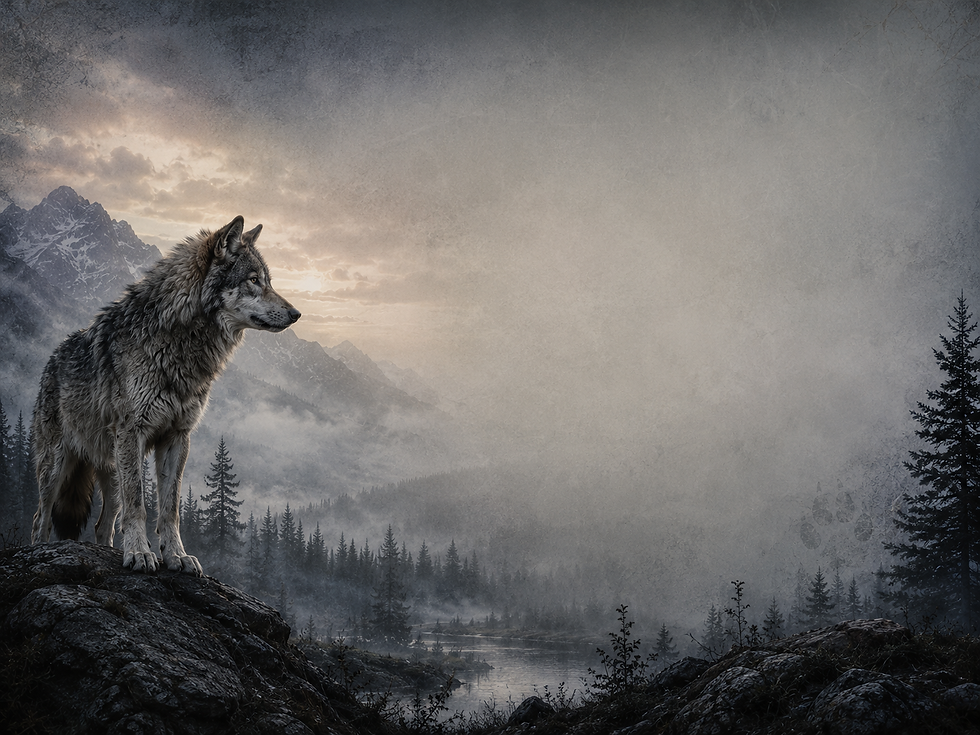
COMMON WOLF MISCONCEPTIONS
Wolves have been surrounded by myths for centuries. Stories, folklore, movies, and outdated observations have often portrayed them as mysterious, vicious, or constantly aggressive animals. Modern research gives us a much more accurate and complex picture of wolf behavior.
One of the most common misconceptions is that every wolf pack is ruled by an “alpha male” and “alpha female” fighting for dominance. The term became popular after studies of unrelated wolves kept together in captivity. Wild packs are generally family groups, usually centered around a breeding pair and their offspring. The parents naturally have authority over their young, so wolf society is better understood through family relationships than through a constant struggle for rank.
Another misconception is that a “lone wolf” is an outcast or a wolf that has been rejected by its pack. In reality, dispersal is a normal part of wolf life. Young wolves may leave their birth pack to search for a mate, establish a territory, or form a new pack. Both males and females can disperse.
Wolves are also sometimes portrayed as constantly aggressive and looking for opportunities to attack. Wild wolves generally avoid people. At Voyageurs National Park, for example, researchers note that wolves are elusive and will usually move away from humans. Wolves can be dangerous wild animals and should always be given space, but aggression is not their constant state of behavior.
A howl is not simply a wolf “calling to the moon.” Wolves howl for several reasons, including communicating with pack members, locating one another, coordinating activities, and advertising or defending territory. Howling is a form of communication, not a response to the moon itself.
Another misconception is that wolves kill everything they encounter. Hunting large prey requires substantial energy and can expose wolves to injury. Wolf hunting success varies, and their hunting behavior depends on prey condition, prey size, terrain, and other circumstances. Wolves can also consume smaller prey and scavenge when opportunities arise.
It is also misleading to think that every wolf pack behaves exactly the same way. Pack size, composition, territory, prey, social relationships, and hunting behavior can vary among populations and even between individual packs. Researchers have documented differences in pack structure and behavior across wolf populations.
The idea that wolves are mindless killing machines also ignores how much of their lives involve activities other than hunting. Wolves travel, rest, communicate, care for young, maintain social relationships, investigate their surroundings, defend territories, and learn from their experiences. Their social lives are a major part of their daily existence.
Another common misunderstanding is that wolves are simply large versions of domestic dogs. Wolves and dogs share a common evolutionary history, but wolves remain wild animals with different behaviors, ecological roles, and adaptations. Their social lives and survival strategies are shaped by life in the wild.
Finally, the idea that there is one simple definition of “what a wolf is like” misses the individuality of the species. Wolves have different personalities, experiences, ages, family roles, and environments. Some may be bold, others cautious; some may take leading roles in travel or social activities, while others contribute in different ways. Researchers increasingly recognize individual variation as an important part of understanding wolf behavior.
Understanding wolves means looking beyond the stories people have told about them. They are neither the monsters of old folklore nor the perfect, harmless animals sometimes portrayed in modern romanticized stories. They are intelligent, social, adaptable wild predators whose behavior makes the most sense when viewed through biology, family relationships, experience, and the environment in which they live.