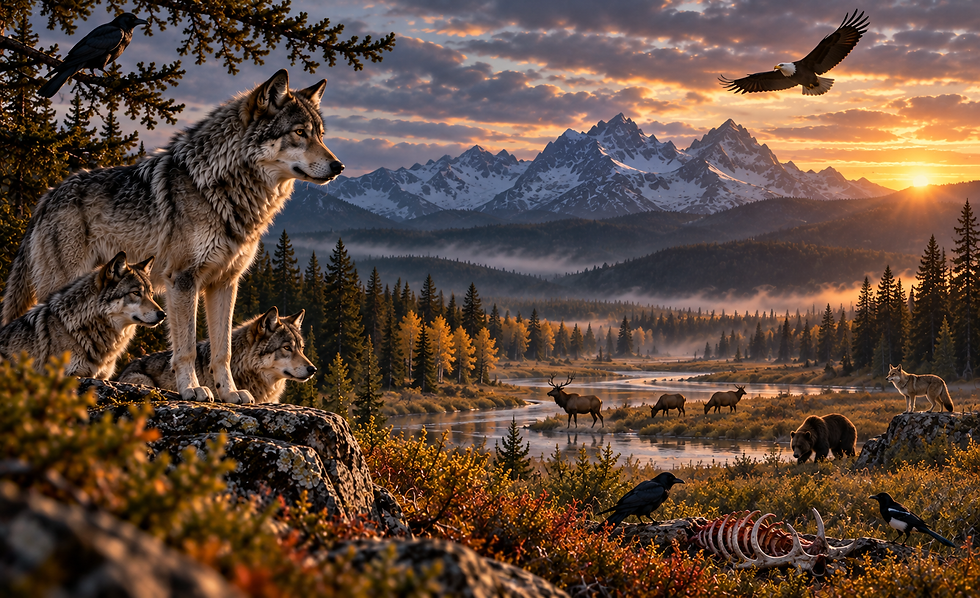
LIFE WITH PREY
For wolves, prey are more than a source of food—they are a major force shaping how packs move, hunt, and use their territory. Wolves commonly hunt hoofed mammals such as elk, deer, moose, caribou, and other ungulates, but the species they rely on varies with region and season. Their diets can also become more diverse when other food sources are available.
Hunting large prey is risky. A wolf can be seriously injured by an animal that is capable of defending itself, so wolves often focus on individuals that are easier to capture. Studies in Alaska and other regions have found wolves disproportionately taking young, old, injured, or otherwise vulnerable prey. This does not mean wolves simply remove the weakest animals from a population; prey selection changes with season, weather, prey abundance, and the circumstances of each hunt.
Prey also respond to wolves. Herding, vigilance, movement, habitat use, and other defensive behaviors can all affect how difficult prey are to hunt. At the same time, wolves must continually adjust their own strategies as prey become more or less available and vulnerable. The relationship is therefore a constant exchange between hunter and hunted—not a one-sided interaction.
Every hunt is part of an ongoing relationship between predator and prey, shaped by risk, opportunity, and the changing conditions of the landscape.
COMPETING FOR THE LAND
Wolves share their habitats with other predators that may hunt many of the same prey. Coyotes, mountain lions, bears, wolverines, and other carnivores can therefore become competitors when food or space is limited. Competition does not always mean direct confrontation; animals may avoid one another, change where they hunt, or alter when they are active.
Coyotes provide a particularly interesting example. In some areas, wolves kill or displace coyotes, especially around food resources, while coyotes can also benefit from scavenging at wolf kills. Research in Alaska has shown that coyotes do not simply avoid wolves at all times—their responses can change with season and the potential rewards of being near wolf activity.
Wolves also interact with larger predators. In Yellowstone, wolves and mountain lions sometimes compete for prey and kills, while bears frequently compete with wolves for access to carcasses. The outcome of these encounters depends on circumstances such as the number and size of animals involved, prey availability, hunger, and the particular species.
Competition is not simply a battle for dominance. It is a shifting balance of risk, opportunity, and adaptation as different predators try to make a living in the same landscape.
THE ANIMALS THAT FOLLOW
A wolf kill does not belong to wolves alone for long. Once a carcass is available, it can become an important source of food for a wide range of scavengers. In Yellowstone, ravens and magpies may arrive almost immediately, followed by coyotes, while bears may attempt to take over the carcass. Eagles and numerous smaller organisms can also feed on the remains.
These relationships are not always peaceful. Scavengers must balance the nutritional value of a carcass against the risks of approaching wolves or competing with larger carnivores. Research in Denali found that wolves and wolverines dominated scavenging activity at monitored carcasses, while smaller scavengers such as coyotes and red foxes used them less and showed greater vigilance.
Ravens are particularly closely associated with wolf kills in some ecosystems. In Yellowstone, ravens have been observed following wolves while they hunt and arriving at carcasses very quickly after a kill. Their ability to locate and exploit these temporary food sources makes them an important part of the community surrounding wolf predation.
A wolf's hunt can therefore become a meal for many other species, turning one predation event into a shared resource within the wider ecosystem.
A NETWORK OF RELATIONSHIPS
Wolves are part of a complex community in which species can occupy more than one role. A coyote, for example, may compete with wolves for food while also scavenging from their kills. A bear may compete with wolves for a carcass but also benefit from the food wolves leave behind. These relationships can shift depending on food availability, season, habitat, and the behavior of the animals involved.
The same complexity applies to prey. Wolves influence the animals they hunt, but prey populations are also shaped by vegetation, weather, disease, other predators, and changing environmental conditions. Long-term research at Isle Royale demonstrates how dramatically these relationships can change over time.
Even scavenging creates connections between species that might otherwise interact very little. A single carcass can become a temporary gathering point for wolves, bears, coyotes, ravens, foxes, eagles, and many smaller organisms—while competition determines who can actually make use of it.
Wolves are woven into a living network of relationships. To understand them, we have to look not only at what they do to other animals, but also at how those animals shape the lives of wolves.